Cambodia Tribunal Convicts Khmer Rouge Leaders
08-07-14
Showing posts with label Cambodia. Show all posts
Showing posts with label Cambodia. Show all posts
Thursday, August 7, 2014
Monday, April 21, 2014
Exclusive Engagement: The Missing Picture
Walker Cinema
Friday, April 25, 7:30 pm
Saturday, April 26, 4 and 7:30 pm
Sunday, April 27, 2 pm
$9 ($7 Walker members and seniors; $5 students)
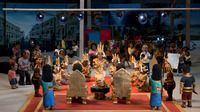
Mixing animated clay figures, archival footage, and his own narration, Phnom Penh-born director Rithy Panh forms a deeply haunting and personal account of his experience with the Khmer Rouge, uncovering untold stories of the many who suffered and those who survived under Pol Pot's faltering cultural revolution.
This "powerful testament to incredible human resilience" (Time Out) won the Un Certain Regard Award at the 2013 Cannes Film Festival and was nominated for an Academy Award.
The Walker Cinema is proud to present this exclusive engagement--this will be your only chance to see the film projected in a movie theater in the Twin Cities.
» Tickets and more information
Friday, April 25, 7:30 pm
Saturday, April 26, 4 and 7:30 pm
Sunday, April 27, 2 pm
$9 ($7 Walker members and seniors; $5 students)
Mixing animated clay figures, archival footage, and his own narration, Phnom Penh-born director Rithy Panh forms a deeply haunting and personal account of his experience with the Khmer Rouge, uncovering untold stories of the many who suffered and those who survived under Pol Pot's faltering cultural revolution.
This "powerful testament to incredible human resilience" (Time Out) won the Un Certain Regard Award at the 2013 Cannes Film Festival and was nominated for an Academy Award.
The Walker Cinema is proud to present this exclusive engagement--this will be your only chance to see the film projected in a movie theater in the Twin Cities.
» Tickets and more information

Wednesday, June 12, 2013
Tuesday, September 6, 2011
Tuesday, June 28, 2011
Will there be Justice? The complexities of the Khmer Rouge Tribunal
At Opening of Cambodia War Crimes Trial, Anger, Doubt and Suspicion Linger
Time Magazine article on the trial.
The truth about the Khmer Rouge is too big for one court case
Opinion piece written by Cambodian journalist and genocide survivor, Thet Sambath filmmaker of Enemies of the People.
Khmer Rouge Defendant Challenges Genocide Tribunal
Defendants claim they have already been convicted and pardoned.
Time Magazine article on the trial.
The truth about the Khmer Rouge is too big for one court case
Opinion piece written by Cambodian journalist and genocide survivor, Thet Sambath filmmaker of Enemies of the People.
Khmer Rouge Defendant Challenges Genocide Tribunal
Defendants claim they have already been convicted and pardoned.
Thursday, June 23, 2011
Cambodia Teaches New Generation About Khmer Rouge Atrocities
A video report produced by University of California, Berkeley's School of Journalism students Jake Schoneker and Mark Oltmanns on PBS News Hour.
A video report produced by University of California, Berkeley's School of Journalism students Jake Schoneker and Mark Oltmanns on PBS News Hour.
Wednesday, December 29, 2010
Holocaust and Genocide Articles
The Holocaust's Uneasy Relationship With Literature
The Atlantic
By Menachem Kaiser
Literature and the Holocaust have a complicated relationship. This isn't to say, of course, that the pairing isn't a fruitful one--the Holocaust has influenced, if not defined, nearly every Jewish writer since, from Saul Bellow to Jonathan Safran Foer, and many non-Jews besides, like W.G. Sebald and Jorge Semprun. Still, literature qua art--innately concerned with representation and appropriation--seemingly stands opposed to the immutability of the Holocaust and our oversized obligations to its memory.
Read full article
The Beleaguered Cambodians
The New York Review of Books
By Margo Picken
More than thirty years after an estimated two million people died at the hands of Pol Pot's regime of Democratic Kampuchea, trials of senior Khmer Rouge leaders and those most responsible for the deaths are at last taking place in Cambodia. On July 26, the first to be tried, Kaing Guek Eav, commonly known as Duch, was sentenced to thirty-five years in prison for war crimes and crimes against humanity--a sentence that he and the prosecution have since appealed. Duch directed Security Prison 21, also known as Tuol Sleng, where at least 14,000 prisoners, mostly Khmer Rouge cadres and officials, were tortured and killed.
Read full article
The Atlantic
By Menachem Kaiser
Literature and the Holocaust have a complicated relationship. This isn't to say, of course, that the pairing isn't a fruitful one--the Holocaust has influenced, if not defined, nearly every Jewish writer since, from Saul Bellow to Jonathan Safran Foer, and many non-Jews besides, like W.G. Sebald and Jorge Semprun. Still, literature qua art--innately concerned with representation and appropriation--seemingly stands opposed to the immutability of the Holocaust and our oversized obligations to its memory.
Read full article
The Beleaguered Cambodians
The New York Review of Books
By Margo Picken
More than thirty years after an estimated two million people died at the hands of Pol Pot's regime of Democratic Kampuchea, trials of senior Khmer Rouge leaders and those most responsible for the deaths are at last taking place in Cambodia. On July 26, the first to be tried, Kaing Guek Eav, commonly known as Duch, was sentenced to thirty-five years in prison for war crimes and crimes against humanity--a sentence that he and the prosecution have since appealed. Duch directed Security Prison 21, also known as Tuol Sleng, where at least 14,000 prisoners, mostly Khmer Rouge cadres and officials, were tortured and killed.
Read full article
Friday, November 5, 2010
Film Premiere Event: Enemies of the People
On Thursday, November 11, at 7:00p.m., Enemies of the People, an award winning documentary, will premiere at St. Anthony Main Theater, 115 SE Main Street, Minneapolis, MN 55414. The screening will be followed by a panel discussion with Director/Producer Rob Lemkin.
Enemies of the People turns the camera onto Nuon Chea aka Brother Number Two, the highest ranking Khmer Rouge leader still alive today. The Khmer Rouge was one of the twentieth century's most brutal regimes. While in power, the Khmer Rouge was responsible for the deaths of approximately 1.7 million people by execution, starvation and forced labor in camps that were later described as the Killing Fields.
In the film, one of Cambodia's best investigative journalists, Thet Sambath, persuades Nuon Chea to admit, for the first time, how he and Pol Pot (the two supreme powers in the Khmer Rouge state) decided to kill party members whom they considered 'Enemies of the People'. The mystery of the Killing Fields is unveiled as the men and women who perpetrated the massacres break a 30-year silence to give testimony never before seen or heard.
Enemies of the People is being screened as part of the Minneapolis-St. Paul Asian Film Festival sponsored by the Minnesota Film Arts Event sponsored by the Human Rights Program at the University of Minnesota and the Program in Human Rights and Humanitarianism at Macalester College.
General Admission is $10.00 and $8.00 for students and seniors.
For more information please contact Nora Radtke at hrminor@umn.edu.
Cambodia events (1).pdf
Enemies of the People turns the camera onto Nuon Chea aka Brother Number Two, the highest ranking Khmer Rouge leader still alive today. The Khmer Rouge was one of the twentieth century's most brutal regimes. While in power, the Khmer Rouge was responsible for the deaths of approximately 1.7 million people by execution, starvation and forced labor in camps that were later described as the Killing Fields.
In the film, one of Cambodia's best investigative journalists, Thet Sambath, persuades Nuon Chea to admit, for the first time, how he and Pol Pot (the two supreme powers in the Khmer Rouge state) decided to kill party members whom they considered 'Enemies of the People'. The mystery of the Killing Fields is unveiled as the men and women who perpetrated the massacres break a 30-year silence to give testimony never before seen or heard.
Enemies of the People is being screened as part of the Minneapolis-St. Paul Asian Film Festival sponsored by the Minnesota Film Arts Event sponsored by the Human Rights Program at the University of Minnesota and the Program in Human Rights and Humanitarianism at Macalester College.
General Admission is $10.00 and $8.00 for students and seniors.
For more information please contact Nora Radtke at hrminor@umn.edu.
Cambodia events (1).pdf
Tuesday, November 2, 2010
Clinton says K.Rouge court vital for peace in Cambodia
Yahoo News
by Lachlan CarmichaelMon Nov 1, 8:39 am ET
PHNOM PENH (AFP) - US Secretary of State Hillary Clinton on Monday hailed the work of a Khmer Rouge war crimes tribunal as "painful but necessary", despite Cambodian opposition to pursuing more regime leaders.
Clinton praised the nation for confronting its dark past after an emotional visit to Phnom Penh's genocide museum, where she saw photos of gaunt-faced prisoners, dozens of skulls of victims and paintings of people being tortured.
The court "is bringing some of the people who caused so much suffering to justice... The work of the tribunal is painful but it is necessary to ensure a lasting peace," Clinton told young Cambodians at a town hall-style meeting.
In a landmark verdict in July, former Khmer Rouge prison chief Kaing Guek Eav, better known as Duch, was sentenced to 30 years in jail for overseeing the deaths of 15,000 men, women and children in the late 1970s.
Last month the court indicted four top regime leaders for war crimes, crimes against humanity and genocide in connection with the deaths of up to two million people from starvation, overwork and execution between 1975 and 1979.
But Cambodian Prime Minister Hun Sen told visiting United Nations chief Ban Ki-moon last week that a third case was "not allowed" because it could plunge the country back into civil war.
Hun Sen was himself once a mid-level Khmer Rouge member before turning against the movement.
The tribunal is currently investigating whether to open further cases against lower level cadres.
Clinton, on a two-week tour of Asia, stopped short of expressing support for new trials, saying there was a need for the international community to "consult closely" with the Cambodian government about its concerns.
She said her "highest priority" was to ensure the cash-strapped court had enough funds to proceed with the second trial, due to begin in early 2011.
After a tour of the genocide museum, the main Khmer Rouge torture centre run by Duch in the late 1970s, Clinton appeared to suggest a harder line towards future prosecutions.
"In memory of the tragic suffering of the people of Cambodia and in hope that there will be a future of peace, prosperity and greater awareness of all that needs to be done to move the country forward, including trials, accountability and reconciliation," she wrote in the museum guest book.
She later described the tour of the prison as a "very disturbing experience".
"Countries that are held prisoner to their past never break those chains and build the kind of future your children deserve," she told the town hall-style meeting.
"I was very proud to see firsthand the willingness of your country to face that past bravely and honestly."
Thousands of inmates were taken from the jail for execution in a nearby orchard that served as a "killing field".
Led by "Brother Number One" Pol Pot, the Khmer Rouge was responsible for one of the worst horrors of the 20th century, wiping out nearly a quarter of Cambodia's population.
Clinton, on the first visit to Cambodia by a US secretary of state since 2003, also used her trip to urge Cambodians not to rely too heavily on China.
"You look for balance. You don't want to get too dependent on any one country," Clinton told young Cambodians when asked about China's growing influence in the impoverished southeast Asian nation.
China -- a former patron of the Khmer Rouge regime -- is the country's top donor, with billions of dollars of investment.
Clinton also met with Hun Sen and some of his political opponents, with the notable exception of fugitive opposition leader Sam Rainsy, who faces 12 years in prison if he returns to Cambodia after being convicted in absentia of uprooting border markings and publishing a false border map.
by Lachlan CarmichaelMon Nov 1, 8:39 am ET
PHNOM PENH (AFP) - US Secretary of State Hillary Clinton on Monday hailed the work of a Khmer Rouge war crimes tribunal as "painful but necessary", despite Cambodian opposition to pursuing more regime leaders.
Clinton praised the nation for confronting its dark past after an emotional visit to Phnom Penh's genocide museum, where she saw photos of gaunt-faced prisoners, dozens of skulls of victims and paintings of people being tortured.
The court "is bringing some of the people who caused so much suffering to justice... The work of the tribunal is painful but it is necessary to ensure a lasting peace," Clinton told young Cambodians at a town hall-style meeting.
In a landmark verdict in July, former Khmer Rouge prison chief Kaing Guek Eav, better known as Duch, was sentenced to 30 years in jail for overseeing the deaths of 15,000 men, women and children in the late 1970s.
Last month the court indicted four top regime leaders for war crimes, crimes against humanity and genocide in connection with the deaths of up to two million people from starvation, overwork and execution between 1975 and 1979.
But Cambodian Prime Minister Hun Sen told visiting United Nations chief Ban Ki-moon last week that a third case was "not allowed" because it could plunge the country back into civil war.
Hun Sen was himself once a mid-level Khmer Rouge member before turning against the movement.
The tribunal is currently investigating whether to open further cases against lower level cadres.
Clinton, on a two-week tour of Asia, stopped short of expressing support for new trials, saying there was a need for the international community to "consult closely" with the Cambodian government about its concerns.
She said her "highest priority" was to ensure the cash-strapped court had enough funds to proceed with the second trial, due to begin in early 2011.
After a tour of the genocide museum, the main Khmer Rouge torture centre run by Duch in the late 1970s, Clinton appeared to suggest a harder line towards future prosecutions.
"In memory of the tragic suffering of the people of Cambodia and in hope that there will be a future of peace, prosperity and greater awareness of all that needs to be done to move the country forward, including trials, accountability and reconciliation," she wrote in the museum guest book.
She later described the tour of the prison as a "very disturbing experience".
"Countries that are held prisoner to their past never break those chains and build the kind of future your children deserve," she told the town hall-style meeting.
"I was very proud to see firsthand the willingness of your country to face that past bravely and honestly."
Thousands of inmates were taken from the jail for execution in a nearby orchard that served as a "killing field".
Led by "Brother Number One" Pol Pot, the Khmer Rouge was responsible for one of the worst horrors of the 20th century, wiping out nearly a quarter of Cambodia's population.
Clinton, on the first visit to Cambodia by a US secretary of state since 2003, also used her trip to urge Cambodians not to rely too heavily on China.
"You look for balance. You don't want to get too dependent on any one country," Clinton told young Cambodians when asked about China's growing influence in the impoverished southeast Asian nation.
China -- a former patron of the Khmer Rouge regime -- is the country's top donor, with billions of dollars of investment.
Clinton also met with Hun Sen and some of his political opponents, with the notable exception of fugitive opposition leader Sam Rainsy, who faces 12 years in prison if he returns to Cambodia after being convicted in absentia of uprooting border markings and publishing a false border map.
Subscribe to:
Posts (Atom)